Decision-Driven Data Strategy
Turn data into an enterprise asset that improves decisions, fast.
The context has changed.
Most data strategies were built for a world of scarce storage, rigid ERPs, and heavy architecture constraints. The goal was to manage data efficiently, govern it, store it, move it, and control cost.
That world is over.
Cloud made storage abundant. Platforms made integration flexible. AI made decision advantage the differentiator. Today, the bottleneck isn’t data volume or tooling. It’s decision quality and decision speed. If your data strategy doesn’t change what leaders decide and how quickly they decide it, it won’t create value.
Our starting point: the decisions that move the business.
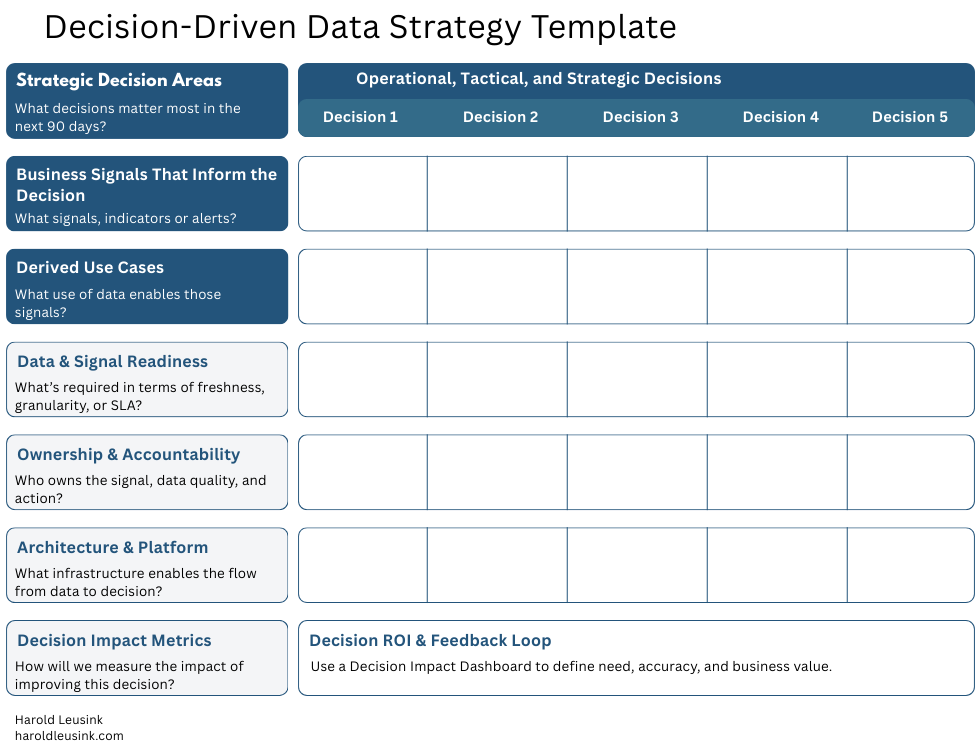
We work with your leadership team to identify the few high-value decisions that drive outcomes, strategic bets, operational trade-offs, pricing moves, customer commitments, capital allocation. Then we work backward to build the data foundation that makes those decisions better.
How it works.
Prioritize decisions that create outsized value.
Define the signals that should guide those decisions.
Map required data to produce those signals reliably.
Design governance + accountability that keeps signals trusted and actionable.
Deliver a roadmap that sequences capability by business impact, not technology preference.
What you get.
A data strategy anchored in business priorities and decision value
Clear signal definitions that eliminate metric churn and misalignment
Alignment between decision-makers and data owners on what matters and why
Governance that enables action, not bureaucracy
A pragmatic roadmap your teams can execute and measure
The payoff.
Better decisions, made faster, with confidence because the right signals show up at the moment they’re needed.
Get a Decision-Driven Data Strategy
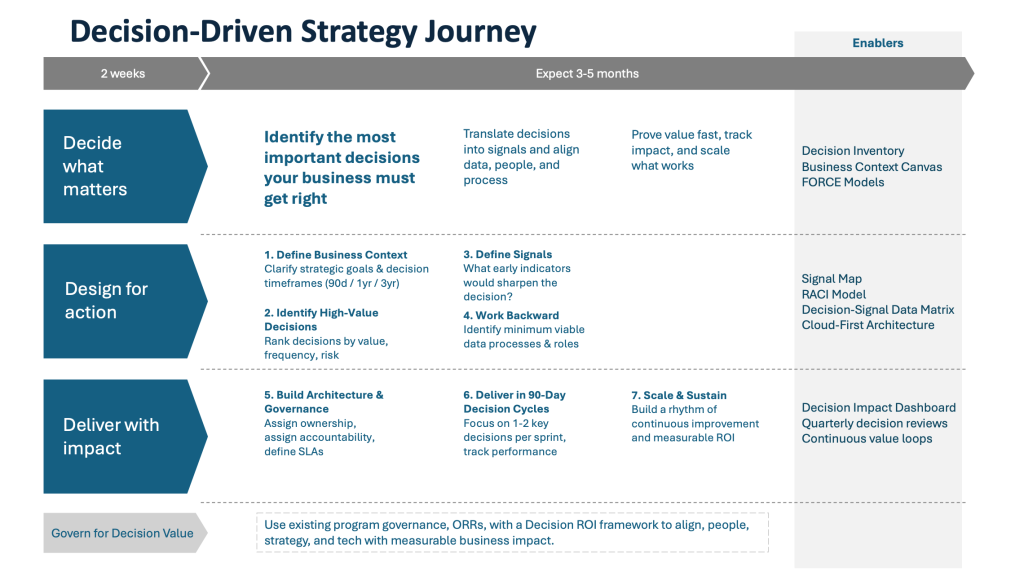
1. Start with the Decisions That Matter
Identify the high-impact, recurring decisions your business must get right, not just projects or use cases, but decisions that shape outcomes.
2. Define the Signals That Guide Those Decisions
Pinpoint the leading indicators, triggers, and early warnings that sharpen judgment and reduce uncertainty. Signals turn data into action.
3. Align Your Data, People & Platforms
Design your data stack to support the signals. Assign clear ownership, ensure signal freshness, and keep the architecture simple, scalable, and accountable.
4. Deliver Results in 90-Day Decision Cycles
Don’t wait 18 months. Prove value in 90 days by improving one key decision. Track ROI with decision impact dashboards and build momentum.